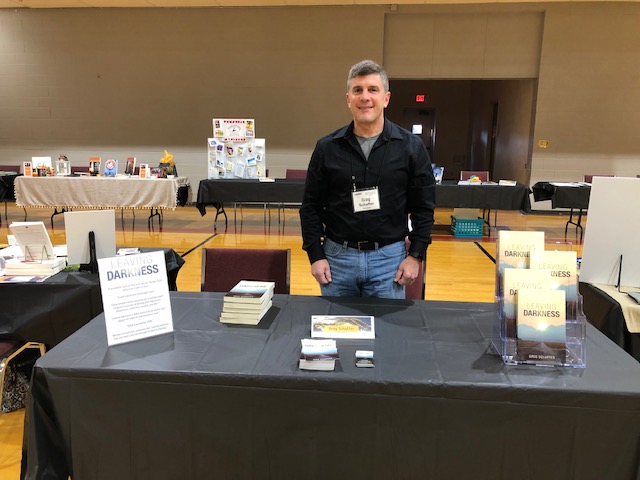
Covered

Leaving Darkness Cover 3 - SubmittedWhat goes into a good book cover? What does “good” actually mean? “You can’t judge a book by its cover,” but we, as indie writers, know better. We try to design a cover that speaks to the target audience, a whisper of “hello” or a shout of “read me.”

Leaving Darkness, my latest novel due to come out this fall (2018), is about the road out of the darkness of depression to the light of living a full life. The path can be difficult – wasn’t it Tom Hanks in A League of Their Own who said: “If it were easy, everyone would do it”?  His character was referring to baseball but isn’t that true in all aspects of life? I think that if leaving darkness was easy, everyone would do it.

The cover, then, had to reflect these and perhaps other elements: light, path, and challenge. I scoured the Internet for royalty-free photos to match these elements and came close a few times. But for one reason or another, I wasn’t satisfied with any I had found.

Such was on the back of my mind as I vacationed with family this past summer in the Grand Teton National Park. I (almost) never write while on vacation, preferring to reset in the relaxing experience unencumbered as best as possible with issues of life. Yet those issues are never far away in the writer’s mind. While walking with my wife in the park late one afternoon, I was moved to take a picture of a road leading towards mountains in the distance.

Several weeks later, I realized that was the photograph destined for the front cover of Leaving Darkness. All of the elements are in place – the road signifying the path to travel, mountains to conquer along the way, and an encouraging setting sun leading to the light.

I submitted this photograph to the publisher, with some enhancements, as the cover basis. I’m excited to see what their graphic designers do with it.

POV Discipline

pexels-photo-287398Earlier this week I sent the completed manuscript for Leaving Darkness to the publisher. As the formatting, cover design, and other work commence, I plan to set aside some time to write about lessons learned. As indie authors, we should look at every opportunity to learn as we progress and hone our craft.

I decided to engage a development editor – that in itself was a smart move and a positive lesson in itself. The lessons in writing alone brought value – it was akin to taking an advanced college course in fiction writing. It helped that the editor I engaged was a college-level instructor as well.

An early and perhaps the most significant lesson from this graduate-level experience is learning what I dub POV Discipline. Of course, the point of view is how the story is told, and there are many examples. I wrote Leaving Darkness in limited third person, following the arcs of two characters, the protagonist and the antagonist. As you can imagine, this created the danger of mixing point of views.

I could have switched and restructured the antagonist’s portions to be seen from the protagonist, but doing so made no sense in the story I was trying to tell. I wanted to show the rise of one, the fall of another. My solution, as suggested by my editor, was to structure each chapter from one of the character’s point of view. Doing so was not easy, but it worked.

Still, there remained some elements of POV crossover. When POV discipline is not maintained from the start, it becomes very difficult to correct as the project matures. We gloss over POV step outs because the story is so familiar to us, yet when pointed out the error becomes so obvious.

Some are easy to cure – instead of, “He worried about what Bill was saying,” we can write, “Bill saw the worried look on Joe’s face after relating the bad news.” We still don’t know for sure that Joe is worried, but the message comes across that likely he is.

I never paid much attention to POV discipline in the past, but going forward it will be forefront in any future fiction project. I suspect some may be thinking, “Well, yeah, that’s obvious, Greg!” but for those of us without a formal fiction writing education, it can be a challenge. It would seem to maintain a consistent POV does not come naturally, rather it is a learned practice.

A Long Day and a Beer (Or Two)

I’m sitting in a pizzeria located on the first floor of my office building, drinking a beer (Atom Bomb IPA or something like that), trying to unwind from a 12-hour workday. I’m exhausted not because I don’t like my job, but because I love it. It’s a blessing to be doing what you enjoy and getting paid for it.

Still, I have a hard time shutting down. I’m in this eatery with this IPA because I’m not done with work, but the shared office space I use is hosting a meeting of a political party. People mingling about my cube is not conducive to reviewing a SOC report (not that a pizzeria is much better, but at least I can order a beer here). For those uninitiated to the wonderful intricacies of information security, a Service and Organization Controls (SOC) report is a summary of an audit on controls of a business to protect information. It is also documented as an effective cure for insomnia.

About 14 pages into this 75 page SOC report (and about halfway into my IPA) I lose what final thread of interest I had in the SOC report. My report on the report to my client can wait a bit longer when I have fresher eyes and a reinvigorated spirit tomorrow. Besides, I have writing on my mind.

The manuscript for Leaving Darkness Leaving Darkness Cover Conceptis in the copy edit phase. That means that I am paying to fix errors caused by all of the times my attention wandered in seventh grade English. I’m fine with that because working with a competent editor helps to sharpen the writing skills I have and introduce others I missed along the line.

But a manuscript is a deeply personal creation, and the thought of someone else changing it in any way is unsettling as well. I have all the confidence in the word that the result will be fantastic, nearly ready for the publisher. Then I will feel relief. This project began over a year and a half ago, and I’m ready for it to be over.

I don’t mean that in a negative way, though I am a bit burned out from the process of countless revisions. Isn’t it amazing that you can read the same sentence dozens of times and miss a glaring error that you should have caught in seventh grade? Oh, yeah, those times of gazing out the window during Mrs. Klein’s English class coming back to haunt me 40 or so years later.

If you’re waiting for the point of this blog, there is none, really. I just needed to get away from the SOC report and everything else information security that I have been concentrating on for my clients over the past 12-plus hours and muster some measure of a creative outlet (whatever that means). I can’t work on Leaving Darkness while it’s in another’s hands, and I’m not going to start a new project until this one is completed. I do have an idea of the next project – the only hint I’ll give is the working title is Desert Death.

Well, my time writing this lasted long enough to necessitate ordering a second beer. Perhaps that was my true motivation after all.

Note – The cover illustration is a concept, hence the iStock watermark. We may end up using that image, or something else.


Leaving Darkness – A Calling

Screenshot 2018-06-25 at 7.13.48 PMToday I completed the revisions to my third novel, Leaving Darkness. The next step is copy editing (hiring someone for that), then on to the publisher. It will be available from Westbow sometime…

This became a long project/process, one that at times has pushed me to the point of obsession. Unlike the previous two novels, which were honestly experiments in learning, Leaving Darkness is without a doubt and by far the most complete, sophisticated, meaningful writing work of my life (to date). I purposefully stretched the boundaries of my comfort zone in order to create a tale of hope.

Reaching down further (and if you’ve read this far, thank you), Leaving Darkness is my response to a calling from God. I was called to write this almost two years ago. It began as a three-sentence outline. Wow – how far it’s come.

Writing Leaving Darkness has influenced my career. I voluntarily left the security of a well-paying job nearly a year ago. Some may question my sanity (that’s okay, I’m kinda used to that). That was also in response to a calling – well, perhaps two. The first, and primary, was that I could do more with my “talents” – not that I was necessarily burying them, but that perhaps I wasn’t using them to give back as best I could. I had no business starting a business, but so far all has been well – in fact, we just signed on a new client this week.

The second reason I left my corporate position was to provide extra time and freedom to write. Now, starting and running a business is a 24x7x365 endeavor – if you don’t love what you do, don’t start a business. That’s not to say it consumes all of my time and efforts. I will say, though, that I may have underestimated just how difficult it has been. Still, I created the world I wanted – needed – to finish Leaving Darkness. I have the flexibility to write when inspiration hits. Plus I’ve gained at least 1.5 hours per day in raw commuting time (even my part-time office is only five minutes from my house).

Unlike my first two novels, which are very complex (but I maintain one day someone will understand the absolute genius of them), Leaving Darkness is a simple tale. It follows one who, well, leaves darkness – the darkness of depression. Perhaps I have committed a basic author mistake – you know the ending from the title (yes, Lowell leaves the darkness). But the story is not that he does, but how he does it – and how it impacts those around him.

I need to be clear though. My purpose for writing Leaving Darkness is not to entertain, although I’m fine if it does. My goal has always been to help those who may be near the decision of choosing a permanent solution to end a temporary problem. Unfortunately, that is all too timely a topic…

So tonight I celebrate a major milestone to a minor project that perhaps might, at some point, help someone lost in the awful cloak of darkness. That was His calling, and Leaving Darkness is my response. Hope and forgiveness are eternal. All we have to do is ask.

#LeavingDarkness

At The Pinnacle

I haven’t blogged for a while, as I have been focused on a few projects. One has reached completion, the most meaningful book I’ve worked on to date – and I’m not the author.

A little over a year ago, my mother approached pinnacle_amazonme with a folder full of papers with articles taped to them, each sheet a component of chapters. What she had done was take running articles she had written over the years, mainly for her local running clubs, and stitched them together in a unique way to tell her story. She began running on a dare in her late 40s and still runs regularly today as she approaches her 80th birthday. Yes, I wrote 80 – what an inspiration!

She asked me for help assembling and potentially publishing her story, as I had self-published a few works myself. Of course, I was going to help – this was her legacy! Thus began a long process, hampered somewhat by the separation of miles (she is in New York, I’m in Tennessee) and the fact that she’s not really a fan of the Internet. But we got it done – At The Pinnacle – One Woman’s Running Journey is available for pre-order, and will be released May 1.

In some way, I think that this was one of the reasons why I learned about the self-publishing route so that I would be prepared when her project came along, though I had no idea prior that this was something she wanted to do. I edited and wrote the foreword and the back cover summary, otherwise, all words are hers. I encourage you to consider her story, and close with the back cover summary:

“Go for it, Mom!” With those words of encouragement, Erika Abraham began a long running journey defined by dozens of years; thousands of miles; countless trophies, medals, and other awards; and many, many smiles. Running brought her confidence, led her to the love of her life, and showed her that despite earlier setbacks and pain, the best was yet to come. Her story is about running, laughing, and reaching new heights.

The Long Wait

My first two novels, in some ways, were experiments. No, maybe that’s not the right word. Learning experiences comes closer to describing the processes and, in some ways, intent. Writing and self-publishing the first novel fulfilled the bucket-list task, the second proved to myself I could, and have a desire to, continue pursuing novel creation.

I like to say that life is about living*, a shorthand statement to summarize that I would rather pexels-photo-121734.jpegtry at something and fail than not have tried at all for the fear of failure. Believe me, I get that fear. I have been ensnared by that fear. It is paralyzing and debilitating, sapping the strength of the desire to try something new, fearful that others may reject the effort.

Writing is one way I counter that fear because I make many, many mistakes as a writer. On the surface that may seem like a contradiction, until realizing that growth is attained through mistakes. When exercising, muscles are torn down and built up. The Internet is filled with examples of famous success stories that are built upon failures. I wanted to learn the process of writing a novel, and to do so I prepped myself to fail repeatedly, not because I had no faith in my skills, rather that I believed in my ability to learn.

True self-publishing is great in that you do everything yourself, from drafting to developmental editing to content editing to layout to cover design to ISBN procurement and so on. Starting from scratch with Ingram Spark about five years ago, I have learned may lessons, enough to fill a book (there’s an idea). Now, as you patiently wait for the main theme of this post, I am in the process of one such lesson – the developmental editing.

If I were asked to pinpoint the most significant mistake I made in creating and publishing my first two novels, I’d state without hesitation they are too complicated. I tried to create a complicated afterlife environment as a vehicle to tell a grand story of temptation, forgiveness, and redemption spanning a century while addressing other heavy issues like abortion, depression, and communism. That’s a lot of stuff to cram into 160,000 or so words. I love the world I created, but cringe at the complexity. Lesson learned.

How could I have averted that? By engaging a professional developmental editor. When drafting my current novel, Leaving Darkness, I defined two changes from the start. First, the story would be simpler and the message more focused, and second I would engage another set of eyes, those who have done this many times before, to review the draft for continuity, story development, and just plain readability.

About two weeks ago I sent the draft manuscript to the developmental editor and three beta readers. I will likely receive feedback from the editor in two weeks, and the beta readers around the same time. For now, I wait and wonder. Is the story too complicated? Does it make sense? Is it fun to read? Is the message I want to convey received? I will summarize the results of the experience in a future post. For now, all I can do is wait.

*John 10:10: The thief comes only to steal and kill and destroy; I have come that they may have life, and have it to the full.”


The Finish Line

1022869

I have run several marathons and many more half marathons over the past twenty years. Inevitably there are well-intentioned bystanders within the last quarter of the distance shouting words of encouragement, including “you’re almost there!” Unless those words come at mile 26 in a marathon, no, I am not “almost there.” Much agony, sweat, and pain remain.

Writing a novel is a similar process. When that rough first draft is completed some (particularly non-authors) may encourage you by saying that you’re almost finished. Nope – not even close. Reaching your desired word count and into your third revision – that’s a time to start thinking about the finish line.

At almost exactly this time last year I began my third novel, Leaving Darkness, about a man’s journey out of depression. I tried a different method that I described as Divide and Conquer. When I wrote this post in March of 2017, I had reached 3500 preliminary words towards my goal of 80,000 using this tactic. This is the update I promised then.

Today Leaving Darkness is substantially complete. At about 79,500 words, I have about reached my goal, and will likely exceed it as the editing and fine-tuning processes continue. Thus, I have essentially written a novel in a year. Considering writing is not my full-time job and I took three months off from all writing to start a consulting business, that’s not bad.

Therefore, my update on Divide and Conquer simply is this: it works. I was able to structure my thoughts logically, added details and plot elements at a measured pace, and never lost my way in the process. Leaving Darkness is by far the best of my three novels. The writing approach contrasts markedly with that of Temptations of the Innocent, written by “stream of consciousness.” That end product also contrasts with Leaving Darkness and was not one of my favorite works, but we learn from mistakes.

After I cross the manuscript finish line, now in sight and about 0.2 miles away, the next step will be to publish the novel. I’m exploring different venues there as well – stay tuned!

Their Words, Not Yours

pexels-photo-256798My two ongoing writing projects are vastly different. One is my third novel, first draft about 90% completed but stalled because of competing priorities. The other is not my work. I am performing the duties of editing, formatting, and publishing. Both will likely be out sometime in 2018.

While I am sworn to secrecy at the moment as to the author and topic of the second work, I know the author, and her story, quite well. Her work is an anthology of sorts, describing events, conquered obstacles, and personal revelations over several decades. It is a pleasure to work on this – just hearing (and in some cases reliving) the tales alone has been wonderful.

Therein is the genesis of a problem I should have seen coming. Being aware of the stories that spun some some vignettes (and mentioned in a couple as well), I began to reword some of her sections in my words based on my memories. I had no malicious intent, nor was I driven by insecurity. I simply was doing for her in the editing process what I do for myself constantly with my works – write, edit, refine, edit, refine, and so on.

Early on I realized I was not simply editing her words - I was replacing them. And not just words. I found myself overruling her style, imposing mine on her work. Again, no malicious intent – my style was better than hers. After all, I was the editor! Oh how arrogant . . .

Once that epiphany hit me, I stopped. Then I really began to read her story through her words. By doing so, I began to unfurl her style – different than mine, unique, and in many instances, better. The primary reason her style trumped mine is because of just that – it was hers, and this was her story.

I trashed the majority of the initial edits and started the process again. This time, I read to uncover her fluidity of prose, riding the descriptors and the twists and turns as she wove her unique tapestries. Instead of taking the blanket and tossing it out in favor of another I liked, I began mending small holes here and there, preserving and (hopefully) enhancing her artistic uniqueness. The work remained completely hers this time – as it should be.

I’m not a professional editor, nor am I trained as such, but I imagine there are courses that teach what I learned above through experience, If there are not, there should be. After all, editors may be writers, but their creativity must be tempered when refining another’s work, else there exists the danger that the original tale, with all of its intricacies in word and form, may be watered down or lost completely.

The Rainbow Bridge

Foxy 2011I haven’t blogged for a while. Truth is, I’ve been quite busy with completing my third novel, editing another book whose author is very special to me, and standing up my consulting business (security, not writing). All this points to life moving on, which it does, all around us. Sometimes that movement is not as pleasant as we’d like.

My wife and I have four adopted dogs, all rescues. One had to learn to hoard food to avoid starvation, and still does to this day, though she has not known a day of hunger for a decade and never will. Another was a tool for breeding, banished for what to her surely seemed like an eternity to a dirty, chicken-wire floored cage, milked for her offspring – she never will live another day without a warm, plush bed. A third kept finding forever homes that were not forever and has separation anxiety, though she never has to worry about lack of attention or abandonment anymore.

Then their is our “red puppy,” adopted nearly seven years ago, found on the side of a road, malnourished, with worms, navigating on a lame foot, and a huge scar on her side that many thought came from acid. Clearly she had been abused. If not for the kind rescuer and the fostering, she would not have survived. When we met her, we instantly fell in love with her because, despite the imperfections, she radiated love in her eyes, if sometimes not her actions. She could be aggressive – who wouldn’t, given her past?

We have loved on this mixed breed with the funny limp for nearly seven years. Early on, no toy was safe, with guaranteed destruction and artifacts manifested as colored poop in the backyard. Her lame leg became an inspiration for the name of one of my home brewed IPAs if only because doing so was so outlandish. She weaved her way though our house, onto our couch, and into our hearts.

Today she is old, quite old. We don’t know her age, but by human years, she is likely about 110. She suffers from Cushing’s Disease, though various treatments have helped. Her quality of life has been strong, but is beginning to fade. We know that the inevitable trip across the Rainbow Bridge is not too far away. I could not finish typing this without tears, because I’m selfish. I know she has to go, likely soon. That sucks.

When we write, inevitably we always draw from elements in our own lives. We transpose emotions onto characters. We make them feel because we feel – they love because we love. We can write about love, and apply it across many instances, because of our experiences – all experiences. Every relationship, human or not, in some way, influences every imaginary interaction we create.

This “red puppy” sleeps soundly at my feet at the moment, after an uncertain day when we thought at today’s sunrise she may not see another sunset but by afternoon she had regained all of her life spirit to continue on. She is still loving life. One day, likely soon, she will silently leave us, or let us know it’s time to let her go. On that day I will gain more experience about loss, but I am so not looking forward to that, despite that it will deepen the well of my experiences from which I draw from when I write.

Goals


Just as every journey begins with the first step, every novel starts with the first word. Ideally, both lead to desired goals. Most don’t begin to travel a road aimlessly; they have a destination in mind. Perhaps it’s the same for authors beginning novels. I can say each of the four I’ve written started with some goal, and with each my reasons and desires for writing have evolved.

My first novel sits in my basement, a collection of wrinkled, dog-eared notepad paper. I have not published it, nor am I sure I ever will, unless my popularity as an author skyrockets to the point of fans demanding early material. One can dream. My reason for writing “The Balance of Power” in high school was to see if I could. Like all budding novelists, I had (have) dreams of breaking through, but back then I think I knew those words would not likely be seen by many. Thus it sits, unread, a heavy tale of a mid 1980s Soviet takeover of the United States, a topic well out of my league then, and perhaps now.

My second novel took twenty years to finish, and my reason for beginning it was vastly different. Going through a divorce, I wrote as therapy. I liked the basis of the story, a time-travel tale to erase mistakes made that led to a heartbreaking split (art imitating life), but no one else did, at least no literary agents. One offensive rejection letter stated the protagonist should have been a woman. Sorry, my life, my story. But it really was not my story, and, truth be told, the first version was sappy, for lack of a better word. Even the original title, “Second Chance,” brought images of cheesy romance paperbacks. Thus, that manuscript sat in a drawer of a filing cabinet for about eighteen years until the self-publishing niche exploded. As a bucket list item, I decided to revamp and self-publish, removing the sap. The work became “Forgiveness,” with the goal of teaching a lesson or two on, wait for it, forgiveness. 

Having figured out all of the nuances of self-publishing (writing is the easy part), I dove into creating the third novel, “Temptations of the Innocent.” My goal was to create a trilogy around “Forgiveness,” with “Temptation” as the prequel. I wrote, and rewrote, and discard, and cursed, and wrote some more, and eventually produced a product that was extraordinarily complex, too much so in hindsight. I met my goal, but learned a lesson, and opted to put the final chapter of the trilogy on hold. I needed a lighter project. I wanted to write about something meaningful.

“Leaving Darkness” draws on my experiences as a volunteer for a Christian-based small group therapy organization and my walk of faith as a Christ-follower, but is in no way autobiographical. I hope to show how both can lead someone lost in the darkness out of depression to experience a full life. My aim is not to be preachy, just to take a simple character that perhaps some in the clutches of darkness can relate to and show how this person, through the small group experience and letting God work in his life, finds peace and fulfillment and discards weighty anchors of guilt and regret. This project has been, without a doubt, the most satisfying to date. My goal? That this light work of fiction helps others.

As authors and as humans, we grow and evolve, and so should our writing goals. As for me, perhaps once I have completed “Leaving Darkness” I will journey to the darkness of my basement and dig out an old manuscript . . .