The Rainbow Bridge

Foxy 2011I haven’t blogged for a while. Truth is, I’ve been quite busy with completing my third novel, editing another book whose author is very special to me, and standing up my consulting business (security, not writing). All this points to life moving on, which it does, all around us. Sometimes that movement is not as pleasant as we’d like.

My wife and I have four adopted dogs, all rescues. One had to learn to hoard food to avoid starvation, and still does to this day, though she has not known a day of hunger for a decade and never will. Another was a tool for breeding, banished for what to her surely seemed like an eternity to a dirty, chicken-wire floored cage, milked for her offspring – she never will live another day without a warm, plush bed. A third kept finding forever homes that were not forever and has separation anxiety, though she never has to worry about lack of attention or abandonment anymore.

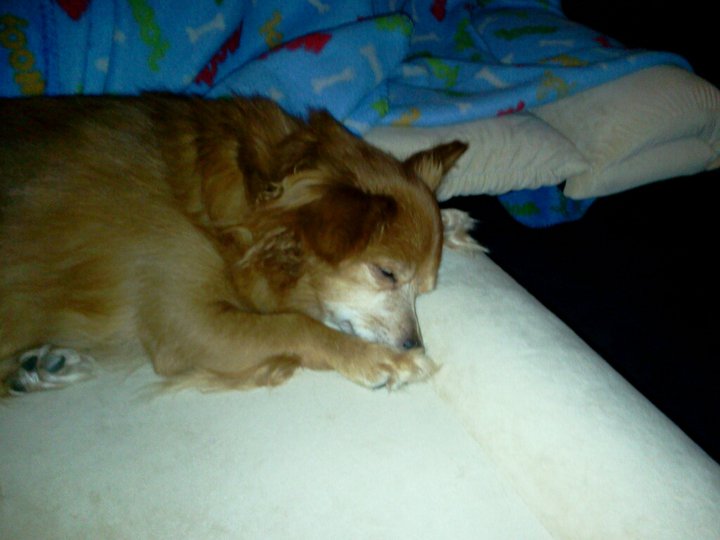
Then their is our “red puppy,” adopted nearly seven years ago, found on the side of a road, malnourished, with worms, navigating on a lame foot, and a huge scar on her side that many thought came from acid. Clearly she had been abused. If not for the kind rescuer and the fostering, she would not have survived. When we met her, we instantly fell in love with her because, despite the imperfections, she radiated love in her eyes, if sometimes not her actions. She could be aggressive – who wouldn’t, given her past?

We have loved on this mixed breed with the funny limp for nearly seven years. Early on, no toy was safe, with guaranteed destruction and artifacts manifested as colored poop in the backyard. Her lame leg became an inspiration for the name of one of my home brewed IPAs if only because doing so was so outlandish. She weaved her way though our house, onto our couch, and into our hearts.

Today she is old, quite old. We don’t know her age, but by human years, she is likely about 110. She suffers from Cushing’s Disease, though various treatments have helped. Her quality of life has been strong, but is beginning to fade. We know that the inevitable trip across the Rainbow Bridge is not too far away. I could not finish typing this without tears, because I’m selfish. I know she has to go, likely soon. That sucks.

When we write, inevitably we always draw from elements in our own lives. We transpose emotions onto characters. We make them feel because we feel – they love because we love. We can write about love, and apply it across many instances, because of our experiences – all experiences. Every relationship, human or not, in some way, influences every imaginary interaction we create.

This “red puppy” sleeps soundly at my feet at the moment, after an uncertain day when we thought at today’s sunrise she may not see another sunset but by afternoon she had regained all of her life spirit to continue on. She is still loving life. One day, likely soon, she will silently leave us, or let us know it’s time to let her go. On that day I will gain more experience about loss, but I am so not looking forward to that, despite that it will deepen the well of my experiences from which I draw from when I write.

Goals


Just as every journey begins with the first step, every novel starts with the first word. Ideally, both lead to desired goals. Most don’t begin to travel a road aimlessly; they have a destination in mind. Perhaps it’s the same for authors beginning novels. I can say each of the four I’ve written started with some goal, and with each my reasons and desires for writing have evolved.

My first novel sits in my basement, a collection of wrinkled, dog-eared notepad paper. I have not published it, nor am I sure I ever will, unless my popularity as an author skyrockets to the point of fans demanding early material. One can dream. My reason for writing “The Balance of Power” in high school was to see if I could. Like all budding novelists, I had (have) dreams of breaking through, but back then I think I knew those words would not likely be seen by many. Thus it sits, unread, a heavy tale of a mid 1980s Soviet takeover of the United States, a topic well out of my league then, and perhaps now.

My second novel took twenty years to finish, and my reason for beginning it was vastly different. Going through a divorce, I wrote as therapy. I liked the basis of the story, a time-travel tale to erase mistakes made that led to a heartbreaking split (art imitating life), but no one else did, at least no literary agents. One offensive rejection letter stated the protagonist should have been a woman. Sorry, my life, my story. But it really was not my story, and, truth be told, the first version was sappy, for lack of a better word. Even the original title, “Second Chance,” brought images of cheesy romance paperbacks. Thus, that manuscript sat in a drawer of a filing cabinet for about eighteen years until the self-publishing niche exploded. As a bucket list item, I decided to revamp and self-publish, removing the sap. The work became “Forgiveness,” with the goal of teaching a lesson or two on, wait for it, forgiveness. 

Having figured out all of the nuances of self-publishing (writing is the easy part), I dove into creating the third novel, “Temptations of the Innocent.” My goal was to create a trilogy around “Forgiveness,” with “Temptation” as the prequel. I wrote, and rewrote, and discard, and cursed, and wrote some more, and eventually produced a product that was extraordinarily complex, too much so in hindsight. I met my goal, but learned a lesson, and opted to put the final chapter of the trilogy on hold. I needed a lighter project. I wanted to write about something meaningful.

“Leaving Darkness” draws on my experiences as a volunteer for a Christian-based small group therapy organization and my walk of faith as a Christ-follower, but is in no way autobiographical. I hope to show how both can lead someone lost in the darkness out of depression to experience a full life. My aim is not to be preachy, just to take a simple character that perhaps some in the clutches of darkness can relate to and show how this person, through the small group experience and letting God work in his life, finds peace and fulfillment and discards weighty anchors of guilt and regret. This project has been, without a doubt, the most satisfying to date. My goal? That this light work of fiction helps others.

As authors and as humans, we grow and evolve, and so should our writing goals. As for me, perhaps once I have completed “Leaving Darkness” I will journey to the darkness of my basement and dig out an old manuscript . . .

A Writer’s Calling


My original intent was to write as my third novel the final chapter in what I sometimes refer to as the “Grace of Innocence” series. My first two novels, Temptations of the Innocent and Forgiveness, paint an interaction between this world and the next, where unborn children are given a second chance at life, time folds in on itself, and good and evil fight it out. I intentionally left several questions unanswered partially because I had created a massively complex backstory. I did not yet have answers to some of those loose threads.

While planning that project, I had several occasions to ponder why I was writing. I Sunrise Natchez Trace Bridge Augustlikened those internal discussions to similar musings after nearly ten years of flying my own small, old airplane. Visions of frequent family visits, vacations to exotic locations, and Angel Flight volunteerism had given way to dull weekly hour-long local flights to keep my piloting skills current and the plane in operating condition. I was not particularly enjoying the experience anymore.

One day I had a revelation, in the form of a question. Was I flying for God’s glory, or my own? I knew the answer, and within three months, I had sold my plane. I decided I would fly again when the time was right. It’s been eight and a half years since then, and the desire hasn’t returned. God had other plans for me, and I’m quite thankful for His hand on my life.

Why was I writing? Was it for God’s glory, or mine? My first novel started as therapy, a coping mechanism when my first marriage dissolved into darkness. I created a fake world where a couple’s strife ended in happiness and love. Pure fantasy, but it did the job. I survived, and the manuscript found a long-term home in a manila folder buried in a filing cabinet.

I returned to that project years later when the indie publishing field emerged. What had been therapy morphed into a completely different story with the key lesson that abortion for convenience is wrong. When I self-published Forgiveness, I felt proud, because I believed in the message it was sending. One of the main characters was so compelling that I needed to write his backstory. Temptations of the Innocent followed two years later, and I was exhausted. I felt empty after its launch.

I realized the source of that void not long after. Forgiveness conveyed a lesson, whereas Temptation was simply a story. I’m not diminishing the second novel; I believe that one day, when I’m a famous author, readers will revel in the genius behind the story. But that’s not today. I had little desire to finish the trilogy now. I wanted to shift gears. I wanted to write for God’s glory, not mine.

Leaving Darkness pulls from both my experiences with a Christian-based support ministry (Restore Small Groups) and my walk of faith to a personal relationship with Jesus Christ. My hope is to convey what I believe is the remarkable healing a Christian-based lifestyle can bring. It is not preachy; rather a contemporary view of how such can affect one’s path. I envision Christians and non-Christians to gain from reading the story I am weaving.

Creating this story is my writer’s calling at the moment. I sincerely believe God whispers in my ear as my fingers float over my Dell laptop’s keyboard in the pre-dawn stillness before work. It’s a work in progress, but I’ve maintained discipline to this calling.

Beginning

Earlier I wrote about my challenges in my approach to wring my second novel and my adoption of a new method for creating the third. Today I finished the first scene of Leaving Darkness, my second working title for this project. “Let Me Help” was the first, but that seemed too, uh, “blah.” sunriseThere is still plenty of time to land on the final title, but I’ll return to this in a bit, as the title itself holds more significance than I had realized before.

The beginning is an important part of a novel – maybe the most critical. The challenge is in creating the hook by teasing the story in a few sentences to engage the reader to want to read more. While there likely have been studies performed to validate my theory, I suspect that many times novels are not read past the first chapter or even scene, having not proved to the reader why they should invest their precious time in assimilating several tens of thousands of words more.

My first draft beginning is as follows:

Lowell Ferguson sat in the cab of the Kenworth assigned by the company, eyes fixated on the flier that claimed the unattainable.

This had been an especially difficult week in the darkness. How he came into possession of the piece of paper he cradled in his slightly trembling hands itself was an odd coincidence.

I have introduced the main character, his occupation, and his struggle in the first sentence and conveyed his failure to overcome and his resistance to try another road that promises resolution but ends up failing to deliver. The second sentence reveals he suffers from depression and the third shows his reluctance to attempt to take initiative to solve his issue, supporting the first sentence.

The other element, one that I am continuing to learn and understand its significance, is the interaction with the title. Leaving Darkness implies the main character will succeed in his struggle, and indeed that is the outcome, sorry to spoil the ending. The power of the story, however, is how the main character reaches that goal. Let Me Help conveys none of that, and thus fails as a title.

Of course, all of this is one person’s opinion, somewhat (all right, heavily) biased. I am involved in a peer-editing group that provides feedback on writing style and content. When the time is appropriate to solicit feedback (likely when I’ve finished the first chapter) I’ll gain insight as to whether my perspective is on track or not. As I have written before, one of the pleasures I get from writing is the learning that accompanies the projects. Realizing the benefit of implicitly weaving the title with the beginning sentences of the book to help create that hook is just another self-taught lesson on the #indiewriting journey.

Fear, Uncertainty, and Doubt

shutterstock_574193302

Recently there has been much in the press about Congress “taking away” the Internet privacy of United States citizens. Internet Service Providers can now intercept and sell usage data. There is quite an uproar, and a push for the “necessity” of using Virtual Private Network (VPN) services to keep privacy intact.

Much of this has elements of perhaps not “fake” news but certainly overblown sensationalism. This is a prime example of what we refer to in the infosec industry as spreading FUD – Fear, Uncertainty, and Doubt.

Read closely, friends – nothing has changed. There was a law passed to enable restrictions that would have gone into effect late this year; that will not happen now. Your privacy online is the same today as it was yesterday.

I, like many writers, enjoy writing when the mood hits. That may mean taking out a notebook on a bus or bringing a laptop to a coffeehouse or bar for a drink and a session of keyboard-pounding. I use a cloud service so that my content is synchronized across devices automatically. Use of the public WiFi comes in quite handy.

“But I thought using public WiFi is insecure, and to never do so?”

Well, yes and no.

I do use a VPN service on all my devices, not because I am afraid the government is spying on me or that my ISP is selling my web surfing habits on the open market (I buy aluminum foil to protect against those threats). No, I primarily use my VPN to mitigate risks of Man in the Middle attacks at public WiFi spots.

My fundamental philosophy about information security is it is risk management. Perpetuating FUD does little to help the problem. Do people not drive at all because of the risk of getting into an accident? Of course not, they mitigate that by ensuring brakes are inspected and operating effectively, driving at a safe speed commensurate with conditions and skill, stay focused (no texting and driving, applying makeup, binge watching, and so on), and choosing routes wisely. Does this mean they will never have an accident? No. But they have reduced the chances substantially.

The same applies to cyber. Understand the risks, then mitigate to a level acceptable to your risk tolerance. Yes a VPN service will help protect your privacy if an ISP opts to sell traffic information, but navigate through the FUD and make your decision a risk-informed one. And stock up on aluminum foil.

(Image shutterstock #574193302)

Divide and Conquer

When I was a network engineer, I leveraged a common if perhapsswitch-2064090_1920 inelegant method to troubleshoot a misbehaving, large computer network I referred to as”divide and conquer.” When the network is so contested that it cannot be managed “in-band,” the offending computer must be physically located.

The basic premise of “divide and conquer” was to pick a spot in the “middle” of the network – usually some core device, a switch or a router (which is what we used to call Layer Three switches back in the day), and examine the device. A badly misbehaving network manifested itself in all lights blinking fiercely or, in extreme cases, almost completely solid. The little green LEDs indicated traffic activity. Bad network events often created a saturation of traffic, thereby clogging the network pipe for those trying to do actual work.

The next step was to determine which half of the network contained the source of the activity. Often these core switches / routers had “backbone” connections connecting to two or a few other core switches / routers. In the simple example where the network has three core switches, unplugging one connection will result in one of two actions (usually): the lights will stop blinking ferociously, or they won’t. If they stop their manic dancing, the source of the problem is on that half of the network just unplugged; if not, it exists on the other segment. Repeat the process as best as possible at the downstream device, until the switch that feeds the misbehaving machine is identified.

As I cogitated on the approach to my next novel project, I wondered if  this divide and conquer – a method to traverse the beginning of a broad overview to the details of the subject at hand – could help bridge from concept to details. Sometimes the best way to answer such a question is to limit the thinking and initiate the doing – so I did just that.

I started with the basic premise of the book,  not much of a story, but having the elements of an interesting tale – a feel-good journey with a happy ending.  From that I developed three acts quite easily – the description of the problem, the path to resolution, and the new world. Here emerged two more characters: an external antagonist and a supporter. My first round of division, into thirds, had tripled the detail and taken little effort.

At this point I put the theory into practice. I divided each act into two parts, again adding detail to each of the acts but nothing detailed. With six sections, I repeated the process and then began again, with each iteration adding more detail. When I reach the end of the fourth division, I will have twenty-four chapter outlines, a healthy goal but not one that I will limit myself to. Each chapter outline contains two to four scenes.

I haven’t yet completed the fourth division, having finished only through the outline for chapter nine (and approximately 3500 words). Still, I have already found this method to be fruitful in drawing out the creative process. I’m not ready yet to call this method of creating a novel a success, of course – but thus far I see promise. Stay tuned for updates!


Indie Publishing – Where to Begin?

franklin-art-scene-february-3-2017

With the release of From the Loft, I have self-published four works. Each provided lessons that have helped improve the process, beginning with the writing and travelling the entire road to marketing. I still have much to learn, but I am in a position now to relay knowledge gained to aspiring indie publishers. After all, to learn and to share are two reasons why I entered the indie writing realm.

At a recent display / signing at the #FranklinArtScene in @DwtnFranklinTN, a man probably about ten years younger than I paused at the book display table, picked up a copy of one of my novels, scanned it, and proceeded to ask about the plot. Excited at a possible sale, I proudly recited the same story summary I have said many times before. My anticipation of financial gain muted as I realized from his change in facial contour that the genre, or perhaps just my representation of such, did not appeal to his taste. Yet he continued to ask more questions, not about the content but rather the creation of the work. With a bit of my ego restored, I relayed my journey from the beginning of the self-publishing process. After a few more minutes of pleasant conversation, he thanked me and wished me luck.

The book remained, my financial stature did not change, yet I, and I hope he, gained from the conversation. Perhaps he was one like many of us who has the dream of writing a novel, who has a burning story within that he wants to express, and that I might have ignited a spark in him to drive forward. I remember when that happened to me. Several years earlier a colleague casually remarked at a social event that the company he worked for, Ingram, was about to launch a major upgrade to their indie author publishing service, Ingram Spark. I too had the dream of becoming a published novelist, having penned an 80,000 work of beauty (to me). However, the traditional path of query letters to publishers and agents had produced little response. I saw Ingram Spark as a possible venue for realizing my dream.

Self-publishing is not easy, particularly when one performs all of the actions. Just creating an eBook file, for example, can cause frustration (see my earlier post PlayOrder does not equal 1-Huh?). Roadblocks are (hopefully) eventually conquered, and with each another tidbit is learned. When I advise other aspiring indie authors, I stress that often the writing is the easiest component of book creation. I think that often such revelation is disappointing, until I point out that there are services that will do all of the post-writing work (editing, cover design, ISBN procurement, and so on). The disappointed look returns when I mention the estimated costs of such services.

Nothing in life is free, and if it is cheap, usually the product will also not meet quality expectations – you really do get what you pay for. I never discourage anyone from paying for services for economics, but for me I maintain complete control over the entire process because I strive to put forth finished products that are 100% my creation. I believe that some other indie writers feel the same, but do not know where to begin. Such is the primary reason I blog about my lessons learned and offer individualized indie publishing consulting services.

As with writing, my motivation is not monetary. I want to pass on the limited but growing knowledge I’ve gained, to pay it forward in a way. I gain great satisfaction in the hopes that perhaps I can help another achieve their dream of publishing a book. Perhaps someday in the near future the man who asked me a few questions at the art scene will join me again, but on the other side of the table, proudly displaying his creation.

From the Loft Released

front-cover-submit-build-3

January 18, 2017 – Second Chance Publishing announces the release of From the Loft, a compilation of previously published humorous vignettes detailing a man who grew up in a city atmosphere learning about life on a mini-farm with several horses to care for. The tales capture the struggles and triumphs of one who grew up surrounded by more concrete than greenery as he discovers through some trial and much error the joys of mini-farm life, from moving hay to fixing gates to witnessing a the birth of a horse to bush hogging.

While fictional, the writer based many of the articles on his own experiences. “I found some humor in my adjustment to the different agricultural lifestyle,” author Greg Schaffer explained. “When the opportunity arose to write a monthly horse humor column, I could not refuse. What, with so much material to pull from, the columns would almost write themselves.”

Most of the articles are very close to their original content, with minor style adjustments, presented roughly but not exactly in the order in which they originally appeared. Both of these changes help to establish a feel of consistency and continuity when compiled together.

From the Loft is available in eBook and print formats at major online retailers. Interested parties may order a personalized, signed print copy from the Second Chance Publishing website at www.rhm.884.myftpupload.com.

Second Chance Publishing is an indie writing resource highlighting independent authors. Visit www.rhm.884.myftpupload.com for more information.

Greg Schaffer has previously published two novels and a collection of poems. He has several projects in the works, including a sequel to Forgiveness and an as-of-yet unnamed novel about finding hope through smothering darkness. Contact Greg at gjschaffer536@gmail.com.

Hey There, Where Ya Goin’?

bj-and-bear

Hey there, where ya goin’?

Not exactly knowin’

Who says you have to call just one place home?

He’s goin’ everywhere

B.J. McKay and his best friend Bear

Thus began the catchy jingle to a late 1970’s television show B. J. and the Bear. Born from the popularity of movies like Smokey and the Bandit, the show followed the lighthearted adventures of a truck driver and his chimpanzee companion. The freeness of an open life on the road spoke to many – apparently not enough, though, as the show only lasted a couple of seasons.

I’m in the contemplation stage of a new novel project. I’m just beginning to hash out the general plot and the main characters. For one of the major players, I’m toying with the idea of placing him or her (have not yet settled on the gender) as a truck driver. That freedom of driving anywhere and everywhere echoes the nature of the character I am trying to develop.

Whenever I create a character, a scene, or a plot element, I strive for realism. While B. J. McKay was entertaining, I assumed the depiction did not emulate the the true life of a truck driver. Still, my knowledge of the trade is quite limited, constrained by my own passenger vehicle driving experiences and sensationalized versions of drivers as represented in pop culture. While I respect the application of the laws of physics on these monstrous rigs and yield appropriately, the life of a truck driver is foreign to me.

One of the cool aspects of creating worlds through the written world is the opening of doors to learning about life outside of our limited individual experiences. Today I have spent perhaps an aggregate of an hour during lunch and after work researching the truck drivers’ world and am already astonished. The sacrifices one makes for such an important – no, a critical component of our economic and life existence cannot be overstated. These men and women basically forgo a regular home life so we can have everything at our fingertips – eggs, iPhones, aspirin, basketballs, furniture, cars, hot water heaters, lumber, newspaper, computers – our life.

Yet almost daily, I see some of my pedestrian drivers visibly upset at truck drivers. Many of them also appear not to understand the basic laws of physics as well. Don’t cut a rig off and slam on the brakes!

Truck drivers’ pay has apparently stagnated over the past two decades, while the economy has, over the same period, flourished (Great Recession included). Yet many take to the roads sometimes seven days a week to drive ten hours to make a living – and make our living. I can’t help but think it takes a special kind of devotion to choose such a life.

But this blog is about writing, not to extol the life of a big rig truck driver. Heck, at this point I’m not even sure if I have the profession’s descriptor correct, and if I don’t, I apologize – I remember vividly when I learned not to call a pipefitter a plumber. To bring a realistic life to the character I am contemplating, one must research. When writing – be it an indie novelist with light book sales or a highly followed author who can command six or seven figures per work – getting all story elements correct is necessary. One-dimensional characters do not advance a plot; they smother it.

So where are ya goin’ with your work? For me, I’m not sure yet. I don’t know at this early stage of the novel development if the character will end up as a big rig driver or something else. Still, I will never look at the pilot of one of those awesome transports the same again. Such is a benefit of writing – the opportunities to learn about the world we all coexist in – but only if we allow ourselves the privilege.

Photo – Screen capture of the opening to B.J. and the Bear S1E3


PlayOrder does not equal 1 – Huh?

epub-toc-edit

When you’re an #indiewriter, you do everything yourself, or you pay others to take care of some of the seemingly never ending elements of the self-publishing process. Part of the reason why I entered the independent author world is to learn about all aspects of publishing, so I of course opted to assign all of the chores to myself. You learn from mistakes – well, let’s say I have learned much, including today, when I entered the home stretch of releasing From the Loft.

Today, after some changes precipitated by rushing to publication as I explained in a previous posting, I loaded all updated files to Ingram Spark, confident they would all pass the file validation process, except for one. I knew I’d have issues with the EPUB file – I always do. And I always forget what the issue solution is.

To create the EPUB files, I use a program called Calibre. It’s an amazing freeware product that is intuitive to use, so much as a freeware product can be. If you’re a self-publisher looking for a great e-book management tool, I highly recommend looking at this product. When I launched my first publication over three years ago, Summer’s Drowning, I did so to learn the basics as I prepped for the release of my first novel, Forgiveness, a year later. I’ll detail some of the mistakes and frustrations of that learning process in a future post (creating the correct PDF format was an extreme challenge that had a wonderful, cost-free solution), but creating the EPUB file was not a major hurdle, except for some minor table of content issues.

Previously, I had subverted that by simply removing the table of contents in the Calibre editor. However, this time around I wanted to understand the errors Ingram Spark said I had made (a minor ego hit, yes, but I’m in it to learn, right?), so I closely examined one of the messages that said the play order did not equal 1.

What the heck did that mean?

Google – what a wonderful tool. Apparently, Calibe attempts to build a table of contents based on metadata in the Word document (I format all of my works in Word – again, a topic for a future blog post). However, if a table of contents is not existent in Word, Calibre makes some odd programming assumptions – that which Ingram Spark throws a red challenge flag at.

Here, Calibre’s table of contents editor is your friend. No, not the CLI emulator as shown in the picture above, but its GUI representation. Yes, I know I’ll get flack from old (and I do mean old) network engineering colleagues who think using a CLI to configure network equipment is akin to blasphemy – and I would agree – but xml coding is not, nor will it ever be, my specialty.

I navigated the editor, created a basic table of contents, saved the file, and submitted to Ingram Spark. Success! Another tidbit learned, satisfying a primary objective – learning.

Now I just hope I remember how to do this when I attempt to create the EPUB for the next project.